Overview
A vintage rotary telephone sits on a table. A visitor picks up the handset, hears a dial tone, and dials a three-digit number. Instead of reaching a person, they hear a voice--a researcher describing a specific moment from their fieldwork, or a student explaining what liminality actually means, in plain language, in under two minutes. This is Calls from the Field: an offline, self-contained listening station built around an analog rotary phone connected to a Raspberry Pi running open-source telephone exchange software. No internet connection required. No screen. Just a handset, a dial, and something worth hearing.
The project sits in a longer tradition of correspondence from the field. Anthropologists have always sent word back--through letters and postcards that were more honest about uncertainty than the published monographs that followed. Margaret Mead's Letters from the Field is not a polished argument; it is a running account of what it was like to be somewhere unfamiliar and trying to understand it. Calls from the Field translates that tradition into a different medium: the telephone call, with its particular quality of intimacy and immediacy, its suggestion that someone is still out there and calling back. The rotary dial matters too. Its deliberate slowness-—pull, release, wait--frames listening as an intentional act in a way that pressing play on a screen never does.
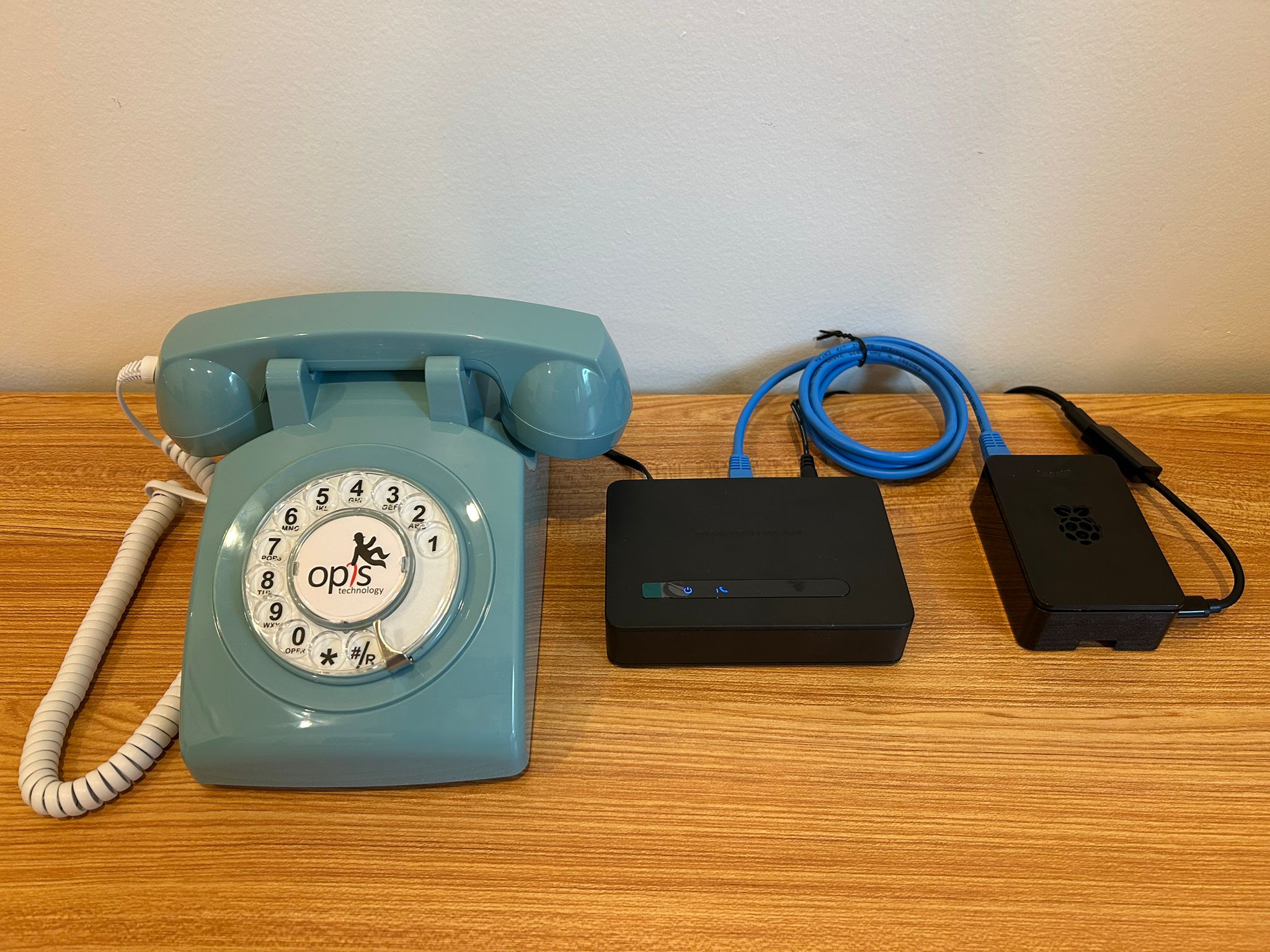
Fig. 1. The complete Calls from the Field system laid out on a wooden surface: the rotary telephone (in powder blue) on the left, the Grandstream HT812 analog telephone adapter (the flat black box, centre) connected to the Raspberry Pi 4 in its case (right). This image shows all three hardware components for the set-up, illustrating how compact and portable the full system is.
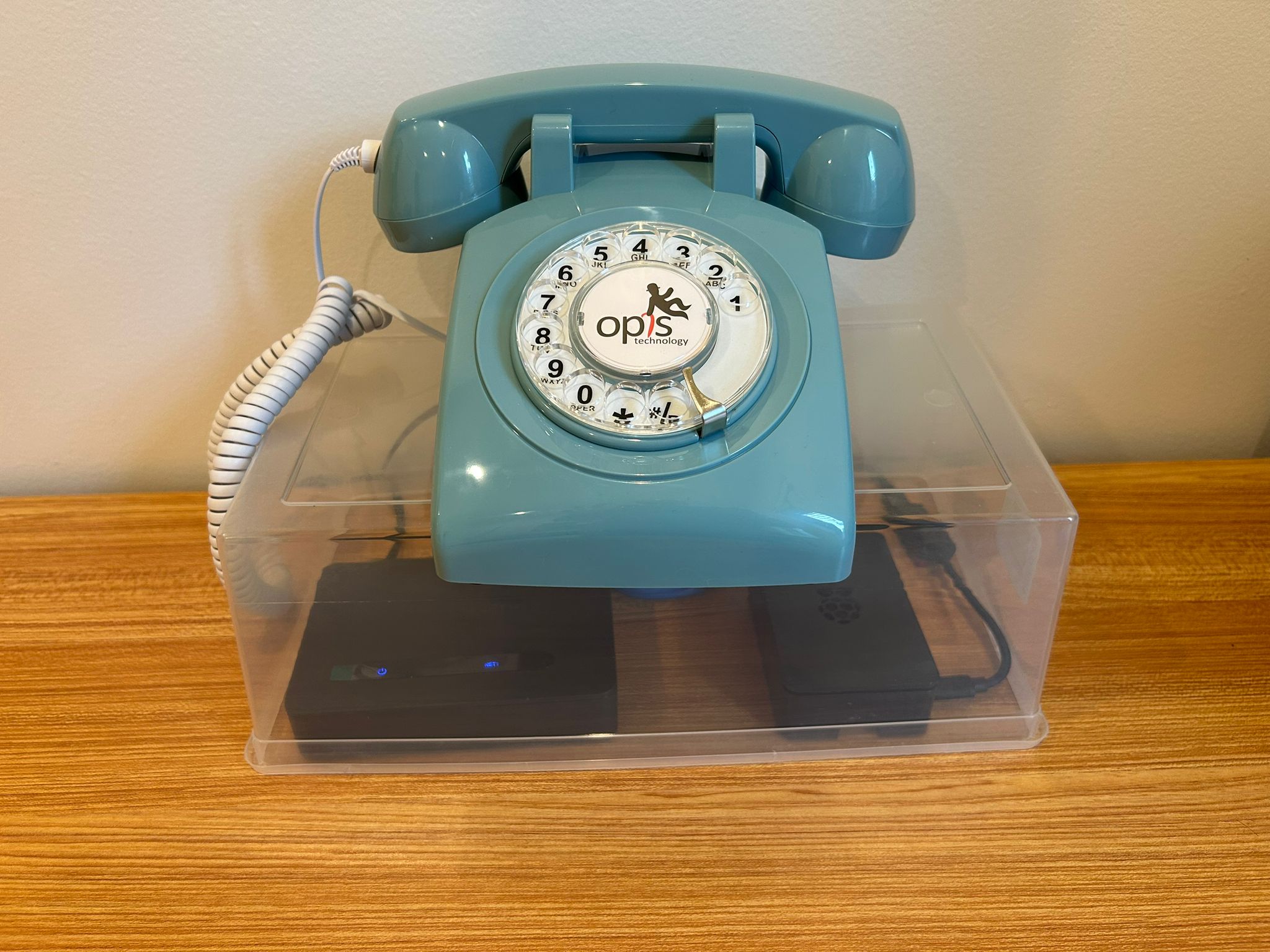
Fig. 2. The assembled installation as it might appear in a classroom or exhibition context: the rotary telephone sits on top of a clear acrylic box, beneath which the adapter and Raspberry Pi are visible through the transparent walls. The setup keeps all components together in a single footprint while allowing visitors to see the technology that powers what they hear. The acrylic box used here is open at the back, which matters: although the Raspberry Pi 4 case includes active cooling, whatever stand or enclosure you use should allow for airflow to prevent heat buildup during extended use.
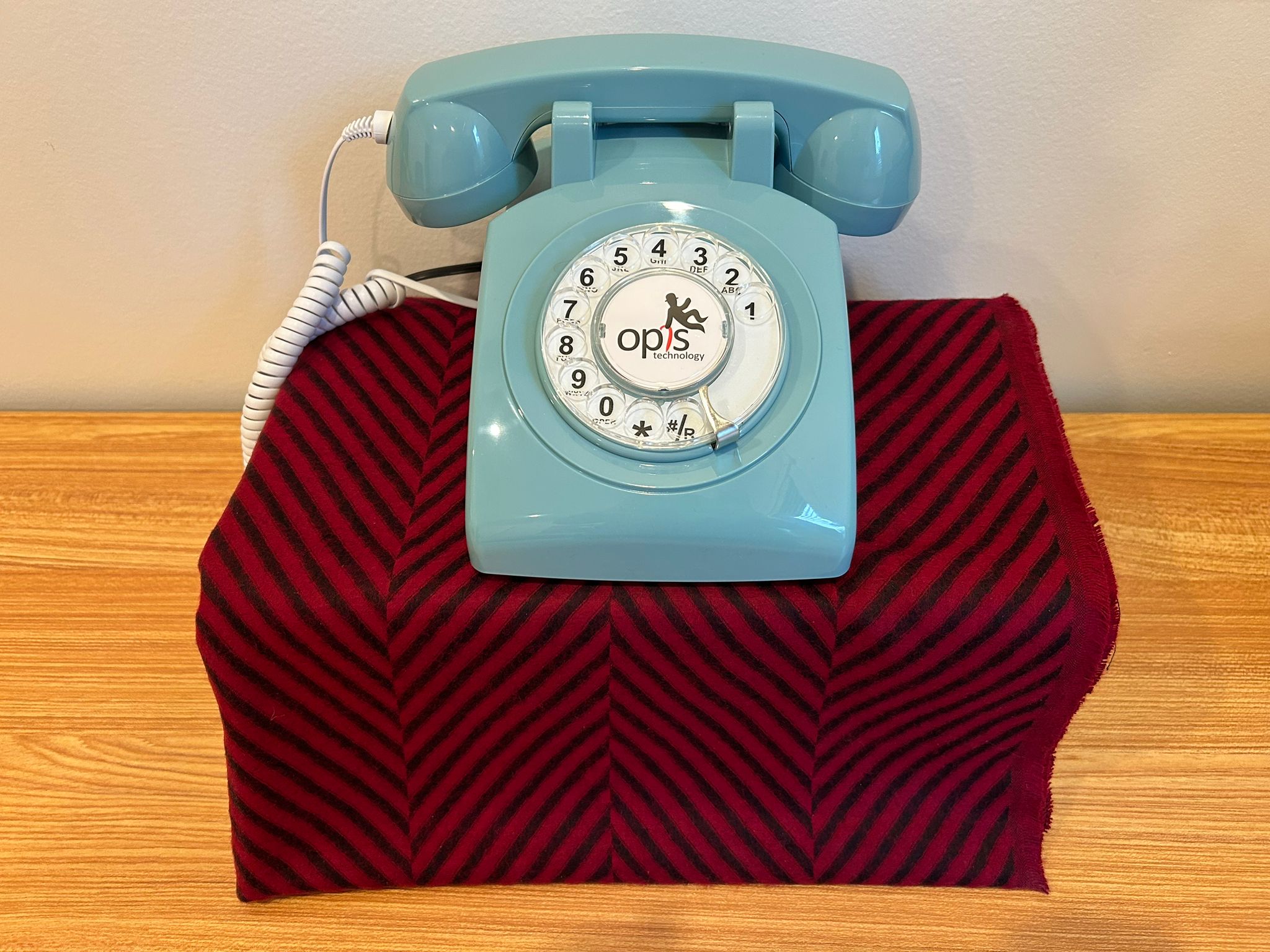
Fig. 3. An alternative presentation of the installation: the rotary telephone rests on a folded textile with a deep red chevron pattern, which conceals the adapter and Raspberry Pi beneath it. The technology disappears; only the telephone remains visible. This configuration foregrounds the tactile and aesthetic quality of the experience—the phone as object, invitation, and interface—rather than the hardware that makes it work.
The system is content-agnostic and built for reuse. An instructor can load it with field stories narrated by researchers (the primary use case), archival recordings of foundational anthropologists, oral histories, curated soundscapes, or short student-produced audio explainers of key concepts. Because it runs entirely offline, it travels: to a classroom, a conference booth, a departmental open house, or a museum installation. It requires no technical expertise to operate once configured, and the project guide below walks through setup step by step for instructors with no background in networking or audio software.
The three sample assignments below show how the station can anchor course-level work at different levels. There are two upper-level assignments: one is desgined for a field school and asks students to share a story from their fieldwork. The other one is designed for an anthropology professionalization course and asks students to interview a faculty member or graduate researcher, elicit a vivid first-person account of a specific fieldwork moment, and produce a 2–4 minute recording as if the researcher were calling from wherever they were. The introductory-level assignment asks first- and second-year students to choose a key anthropological term and record a short audio explainer-—direct, jargon-free, grounded in a concrete example-—in the spirit of a social media explainer. In both cases, the finished recordings go directly into the phone system, making the outcome of the assignment tangible and public. Both assignments also include an accessibility step, asking students to produce a written version of their content for visitors who are deaf or hard of hearing.
Project Documents
Below you can find three project documents: the project guide walks you through the steps to set up the system; the other two documents are sample assignemnts illustrating use cases for the project—one for an upper-level undergraduate professionalization course and the other for a lower-level introductory course.