A vignette is a short dramatic description, some of which typify by creating a composite of all the people or events studied. Others dramatize a person, act, event, or activity so as to catch the attention of the reader; still others summarize a biography, event, or other phenomenon.
— Analysis and Interpretation of Ethnographic Data: A Mixed Methods Approach, Second Edition, by Margaret D. LeCompte and Jean J. Schensul; p. 269
Overview
Ethnographic vignettes, as concentrated snapshots of the broader ethnographic narrative, are not merely descriptive but deeply analytical. By distilling complex social realities into focused moments, they demand careful interpretation, offering a valuable opportunity to hone analytical skills essential to ethnographic practice. At the same time, as stories nested within larger narratives, vignettes employ the full range of storytelling techniques—characterization, pacing, sensory detail—allowing writers to refine their craft and engage readers more effectively. Importantly, however, vignettes are more than just representational tools; they are epistemological instruments. As a distinct genre, they compel us to consider how knowledge is generated in the first place, revealing the choices ethnographers make in framing observations, selecting details, and constructing meaning. Thus, learning to write ethnographic vignettes is not simply about mastering a style of representation—it is about understanding the very process through which ethnographic knowledge is produced, negotiated, and communicated.
The Random Ethnographic Vignette Printer is an open-access, interactive tool designed to support training in ethnographic writing. It combines a digital interface, database, hardware, and website into a system that encourages close reading and reflection on ethnographic vignettes, paired with short lessons in ethnographic writing. The diagram below illustrates how the tool works.
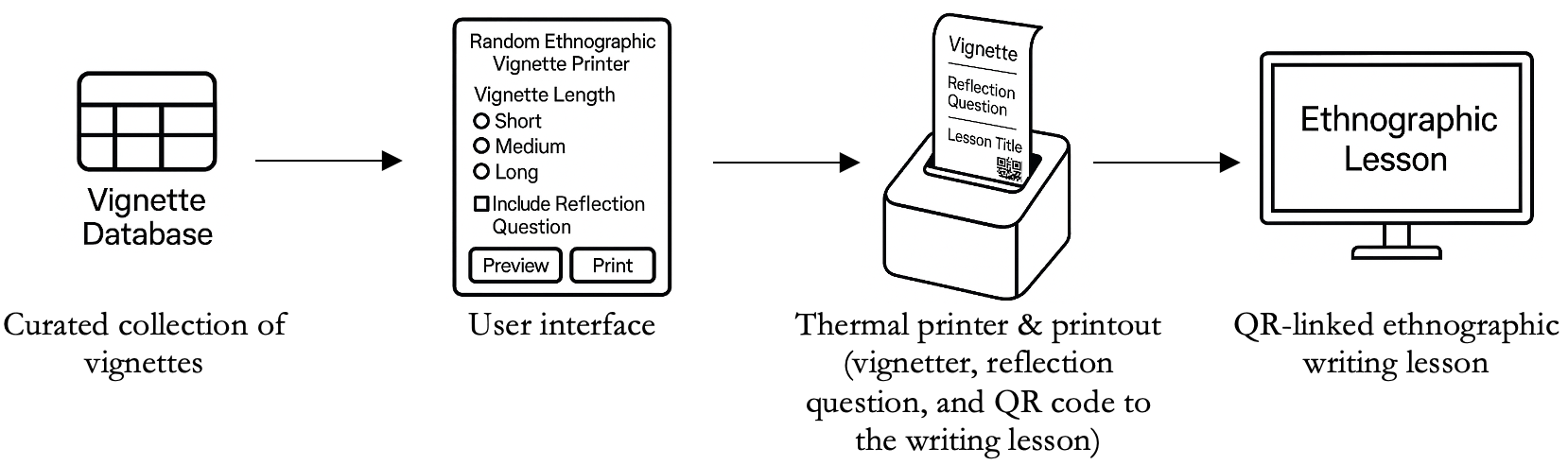
This project is still under development. More detailed descriptions and instructions will be added to this page as it progresses. In the meantime, the underlying code is available on GitHub, allowing facilitators and instructors to adapt and extend the tool. The curated database of vignettes is also open-access, shared under fair dealing for educational purposes.
The project is designed to be collaborative. Users are invited to contribute by suggesting vignettes from published ethnographies or sharing excerpts from their own ethnographic writing. (Please contact me if you’d like the assignment prompt and instructions for inviting students to contribute vignettes to the collection.)
A central feature of the tool is the set of QR-linked short lessons in ethnographic writing. Each vignette printout includes a QR code that directs students to a relevant lesson. These ten lessons are designed to guide close reading, writing, and interpretive discussion. Each lesson highlights a recurring theme in ethnographic practice and follows a common structure: a short conceptual introduction, focus, learning goals, and suggested activities. Some lessons also include a “Learning from Creatives” section, which draws connections to techniques used by artists and writers. Below are the current short ethnographic lessons.
I gratefully acknowledge the financial support for this project provided by UBC Vancouver students via the Teaching and Learning Enhancement Fund.